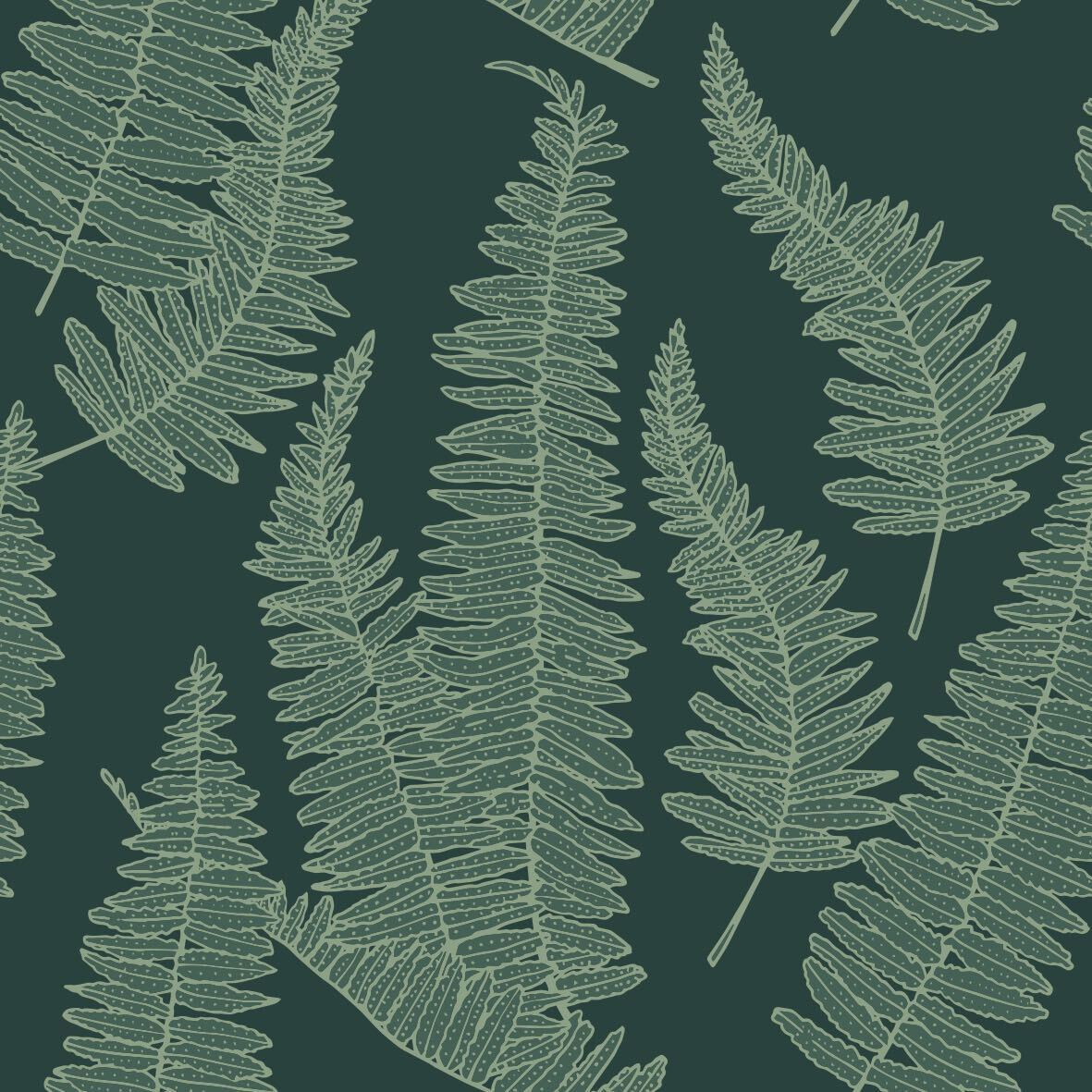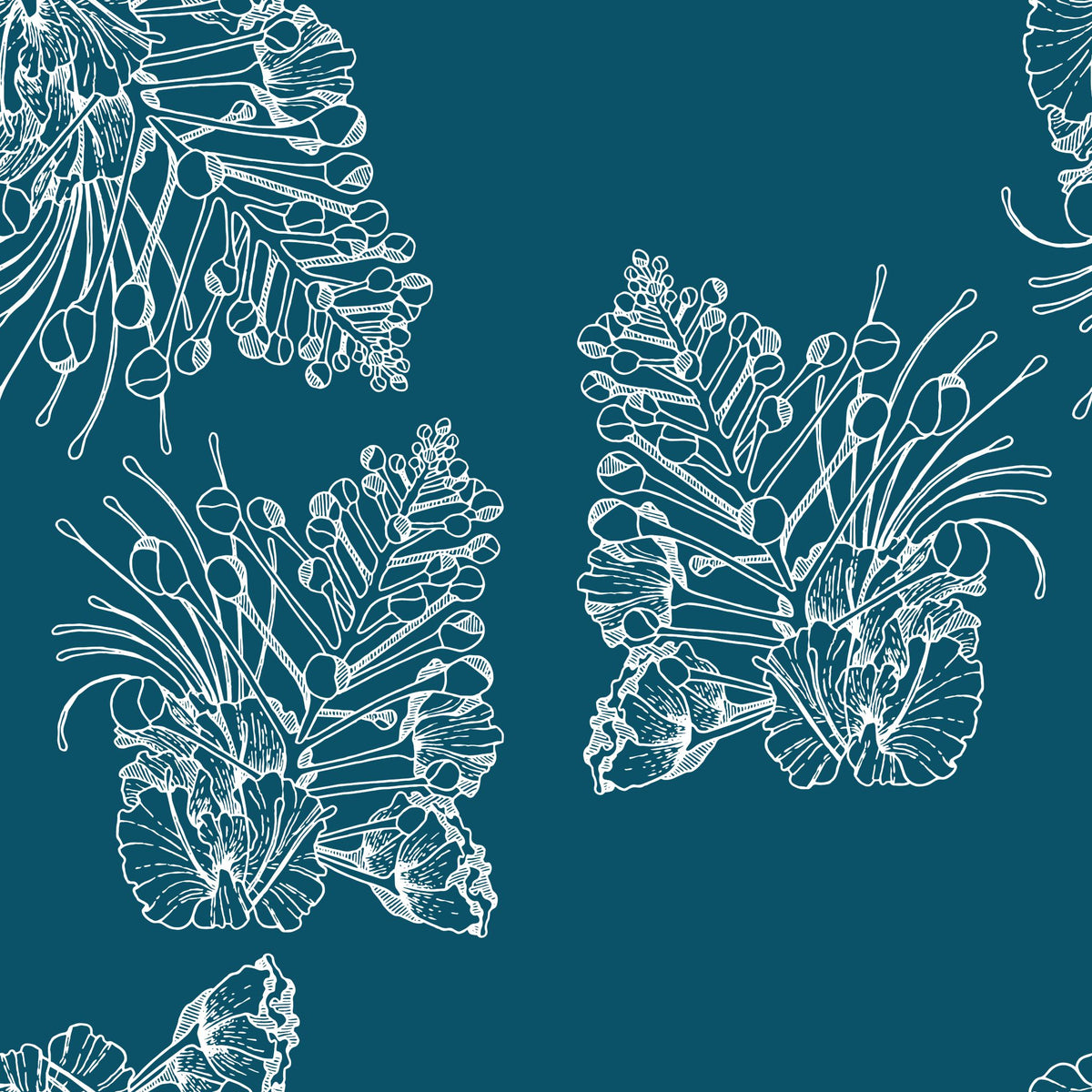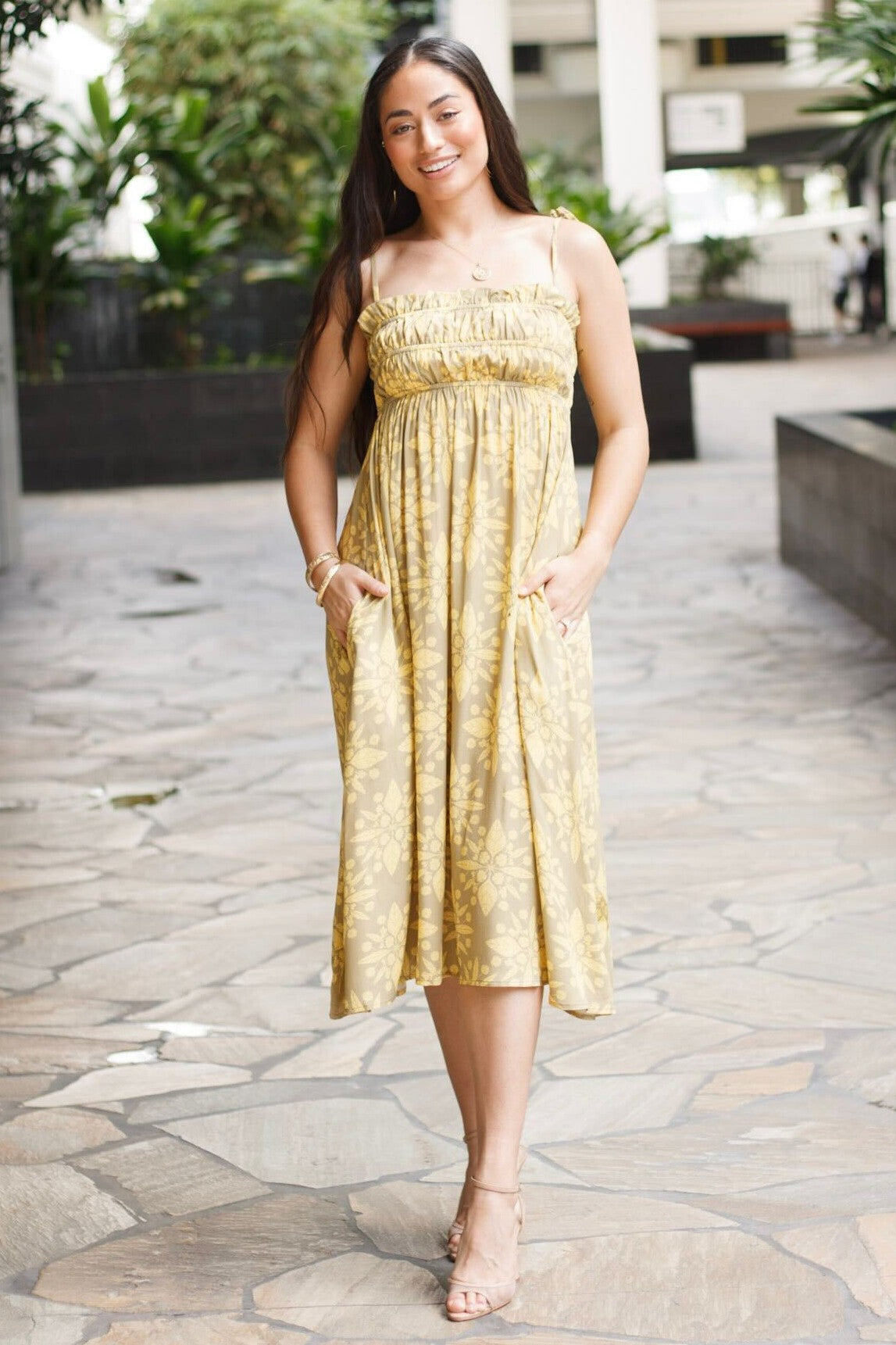
As the warmth of summer gives way to the cool embrace of fall, we welcome our newest Kahulaleʻa print: Nohoanu. Endemic to Hawaiʻi, this native geranium—known as the “cold dweller”—thrives in cooler environments, with silvery leaves and blossoms of white, pink, or magenta. Its jagged, toothy lau (leaves) embody a uniqueness and ruggedness, reminding us of Hawaii’s varied landscape that often reflects the duality of beauty and resilience.
The second print release in our newest collection is inspired by the endemic Hawaiian morning glory plant, Pā‘ū O Hi‘iaka. Translated to the “skirt of Hi‘iaka,” there are multiple mo‘olelo that are connected to this coastal crawling vine. In one legend, it describes how Pele brought her baby sister, Hi‘iaka, with her to the beach to go surfing. As Pele is surfing, Hi‘iaka, who is on the beach, becomes uncomfortable from the hot sun, and the small vine-like plant grows over her to provide shade. In her later life, another legend states that Pele sends Hi‘iaka on an epic journey to search for Pele’s lover, and she is adorned with a magical skirt, Pā‘ū O Hi‘iaka, to help protect and guide her on her journey.
My favorite stories are love stories, but not all love stories have a fairy-tale ending. So is the story of Princess Naupaka and Kaui, a fisherman. Naupaka’s sister, Pele, was jealous of their love and went after them with a vengeance. To escape her wrath, Naupaka took the flower from behind her ear, tore it in half, gave one half to Kaui, and kept the other half for herself. With this, one fled to the mountains and one fled to the sea, forever separated but symbolized as two parts of a whole. Today, you will find these half flowers, Naupaka Kahakai by the sea and Naupaka Kuahiwi in the mountains, longing for the day that they can be reunited.
Through time and space, their story will be told. One thing is for sure, their love is ... Legendary.
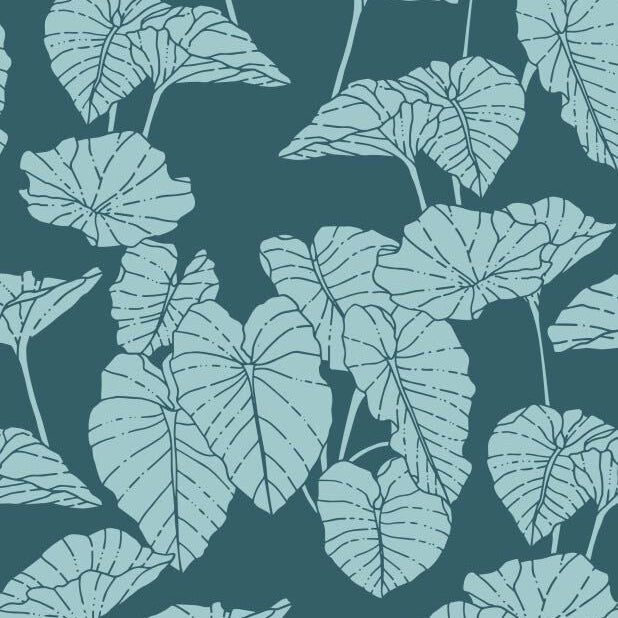
Inspired by my grandmother’s cherished quilt pieces, this print honors her Kalo (taro) quilt pattern—hand-stitched with love in her home in Makuʻu, Puna on Hawai’i island. The design element reflects the deep roots of ʻohana, nourishment, and connection to ʻāina.
Hawaiian quilting, born from the fusion of native artistry and 19th-century Western influences, is more than craft—it’s a legacy passed from one generation to the next. This print is a tribute to her hands, her heart, and the stories woven into every stitch.
This print is named for the rain of my home in Puna—Ka Ua Moaniani Lehua O Puna, the rain that carries the scent of the lehua blossom. In Hawai‘i, rains and winds are given names, each one unique to its place, its rhythm, its story. This is the rain I grew up with—gentle and fragrant, wrapping the land -and my memories- in a lehua scented mist.
Hāpu‘u grows slowly, over decades, even centuries, standing as a reminder that true strength is patient, grounded, and enduring, where wisdom and beauty are passed quietly through time. Inspired by the forest of Hāpu‘u surrounding my home in Pu‘u ‘Ōhi’a, Oahu, this print honors ancient resilience and the legacy held within our native forests, carried softly from one generation to the next.
Puna Niu was born from memory. From the way the coconut trees leaned toward the sea along the coastline of my tūtū's home in Puna, their fronds whispering in the wind like lullabies only keiki and kupuna could understand.
Summers there were sacred. The air was heavy with ehukai, the salty sea spray clinging to our skin as the Niu danced overhead. I remember the golden light of a sunset catching on the leaves, sad to see the day slip away, yet thankful that this place was my home and I’d be back for another day.
This print is a remembrance of those Niu, to that coastline, to the quiet power of our childhood places. A print that holds the stories of our land and lineage—strong, graceful, unforgettable.
Whenever you see a lei print woven into one of our designs, it’s often a reflection of my roots as a hula dancer, and the leis we would adorn ourselves with for certain mele, each one chosen with care, intention, and feeling.
But beyond my own experience, many leis carry even deeper meaning when tied to someone’s personal story and lineage. One beautiful example is Aunty Leimomi Ho, a revered Kumu Hula from Oʻahu, who has shared with us the heartfelt reason behind her love for the lei loke.